
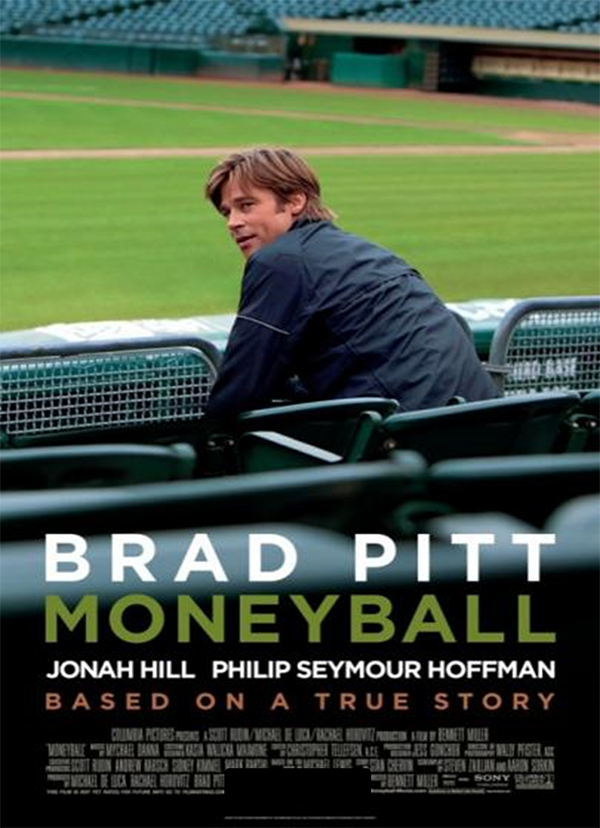
Let the ProRRT℠ help improve your investment selection the way “MONEYBALL” forever changed baseball player selection.

What’s “MONEYBALL”?

It’s not just the name of a very popular movie which, if you haven’t yet seen, you should. It’s the name given to a whole new way of comparatively evaluating baseball players – using performance metrics rather than the subjective opinions of baseball “scouts.”

The movie tells the story of how this occurred, and the struggles involved in changing the traditional system of baseball player evaluation and selection. It’s definitely worth watching.

What’s the connection with DTC’s Professional RapidReview Tool (the ProRRT”)? In an almost identical way, we’re improving the way mutual funds are evaluated and selected.

The time-consuming, initial screening process for picking funds for further, qualitative due diligence, is no longer about the size and reputation of the fund companies, or the size of their advertising / marketing budgets, or their name recognition, or the opinion of external or internal experts . . . and it’s certainly not about incentives that fund companies may be offering to have their funds preferentially recommended. NO!

With the ProRRT, it’s now (just like in MONEYBALL) purely about performance!

Which of the mutual funds and ETFs, within any asset class, have proven best over time at producing the investment results you’re seeking for any one or more of your clients?

Reference to the movie provides clients with an easy-to-understand description of the process you are using . . . a unique process that clients can both actually watch you perform and in which they can participate.

But that’s only a part of why the ProRRT is better than the system described in the movie.

In the movie, the comparative evaluation had to be done by a hired “Quant”, who created algorithms with which the comparisons were performed. No one but him really understood how to use it and (at least initially) almost no one trusted him or the results and recommendations he was producing.

But, as the movie documents, that ultimately changed.

Why?

It was because of the results – better players, better performance, and lower overall costs.

The proof?

They were winning. They were beating the competition!

How is the ProRRT “better?”

What took who knows how much time for the team’s expert “Quant” to comparatively evaluate baseball players, can now be done for hundreds of mutual funds and ETFs in any asset class in mere moments.

And, most importantly, you don’t need to be a “Quant” to do it. You can easily and rapidly perform the scoring and ranking of the funds yourself.

Just as with the MONEYBALL process, the ProRRT℠ helps you identify and select mutual funds and ETFs that better match the composite investment performance (the desired combination of risk, return, and other factors) you’re seeking and often with lower overall costs.

The proof?

After more than a decade of testing, we saw that the mutual funds and ETFs picked with the aid of the ProRRT℠ were winning. We saw that they were beating the competition!

You can now see and, better yet, experience and prove this for yourself.

The MONEYBALL system has forever changed professional sports.

The Boston Red Sox now have as many as 35 people working on analyzing “sports metrics” for the evaluation and selection of players.

The ProRRT℠, in contrast, enables you alone to quickly and easily comparatively evaluate over 20,000 mutual funds and ETFs (many more choices than there are baseball players) for your clients’ investment “team” (the mutual funds and ETFs comprising their portfolios).

If your RIA or Bank has an internal group comparatively evaluating mutual funds and ETFs for its investment advisors to recommend, the ProRRT℠ will help make them much more time-efficient and much better at their jobs.

Our Goal is to similarly improve the way mutual funds and ETFs are evaluated and selected, by empowering you (and members of your investment advisor team) to do something even more extraordinary than what the movie describes – something never before available.

It’s the best of MONEYBALL and it’s now available to you and your RIA or Bank!

eric_smith

Eric S. Smith, J.D.

Eric S. Smith, J.D. is CEO of Decision Technologies Corporation, and President and Investment Advisor Representative of Trustee Empowerment & Protection, Inc., a Registered Investment Advisor


Twitter
LinkedIn

The mental and emotional tension of knowing what you should do and yet not doing it is a simple explanation of Cognitive Dissonance.

If we look, we can find its negative effects in many areas of our lives. If you are an investment advisor looking to grow your business and better serve your clients, it can be particularly harmful . . . even more so if you are unaware of its existence and its negative effects. Of all of the many things that you ideally should be doing, in this post we’ll focus on just one.

If you are reading this, you are likely aware of the ProRRT , the Professional RapidReview Tool℠.

Are you using it to recruit clients away from your competition?

That’s what it was specifically designed to help you do.

Are you using it to improve your investment recommendations and the investment results and satisfaction of your clients?

It was specifically designed to do that as well. Would you really not wish to have a compelling competitive advantage in new client recruitment and would you also not wish to improve your investment recommendations to, and investment performance of, your clients?

Yet even though this newly available tool was designed to directly assist in doing both, very few investment advisors have made any effort to try it.

Have you? If not, why not?

Your answer, or inability to logically answer, may reveal how and to what extent Cognitive Dissonance is negatively impacting your business development goals and the quality of the services you’re providing, perhaps dramatically.

Cognitive Dissonance is almost always objectively illogical and becoming aware of it is the first step in ending its negative effects.

But there is yet another aspect of Cognitive Dissonance that is more general, less visible, and industry specific that may be affecting you. And because it may similarly affect such large numbers of investment advisors (and industry leaders), the resulting illusion of a “strength in numbers” validation can make it difficult to recognize and even more difficult to remedy.

The Encyclopedia Britannica, describes it in this way:

“Cognitive dissonance, the mental conflict that occurs when beliefs or assumptions are contradicted by new information. The unease or tension that the conflict arouses in people is relieved by one of several defensive maneuvers: they reject, explain away, or avoid the new information; persuade themselves that no conflict really exists; reconcile the differences; or resort to any other defensive means of preserving stability or order in their conceptions of the world and of themselves.”

What beliefs or assumptions could be at stake here, in the financial services marketplace? How about starting with these:

  • There’s nothing truly new within the financial services world,
  • There’s no way to determine which mutual funds or ETFs may be best for any client (there are just too many and too much information about them),
  • The process I’m using to select mutual funds and ETFs to recommend to my clients is as good as anyone’s, and
  • My clients like and trust me, I downplay and don’t focus on returns, and I have no real fear of competitors.

Is there any new information that could contradict these beliefs or assumptions?

The answer is YES, absolutely.

The introduction of the ProRRT℠ and knowledge of its capabilities is the new information that contradicts every one of these, including the last one listed. If you’re not fearful of those using the ProRRT℠, you should be. Advisors using the ProRRT℠ will be recruiting clients away from investment advisors who are not using it.

But what’s coming is more of a threat than most investment advisor might imagine. The recent release of a simplified, individual investor version of the ProRRT℠, the Retail Investment Tracking Application℠ (aka “Rita”) will soon provide individual investors with more knowledge about the relative performance of their mutual funds and ETFs than the advisors who (without the benefit of the ProRRT℠) recommended them. The Rita Effect℠ is something virtually no one yet sees coming and for which advisors (other than those using the ProRRT℠) will be woefully unprepared.

The defensive maneuvers that the Encyclopedia Britannica then describes as being employed for the purpose of “preserving stability or order in their conceptions of the world and of themselves,” include: “they reject, explain away, or avoid the new information; persuade themselves that no conflict really exists; reconcile the differences; or resort to any other defensive means . . . .”

If you recognize any of these in your behavior, it’s a safe bet that Cognitive Dissonance is negatively affecting you and your future.

How much of this is intentionally being done, or is simply an uncritical, “go with the flow” acceptance of the status quo, is largely irrelevant. The negative effect is still the same.

So what’s the remedy?

Well, the first step in remedying any problem is to be aware that the problem exists. We hope that the discussion above has helped you to recognize the signs of Cognitive Dissonance and how they may be manifesting in your conscious and subconscious behaviors.

Having that awareness, the next step is NOT to indulge it but to directly act against it. In the present context, that action would be to simply try the ProRRT – to put it and its claims (the truth of the “new information”) to the test.

Cognitive Dissonance and its negative effects fade in those who are willing to do so and are prepared to accept and act on the results that they experience for themselves.

So, what do you want to do?

Do you want to stay trapped in Cognitive Dissonance, where nothing new is possible . . . where you continue to do the same things, in largely the same ways, as everyone else?

Or do you want to try something new and open yourself to the opportunity of better results for yourself and your clients and, in doing so, also help to beneficially change the financial services world?

The choice is yours. We hope you make it a good one. We’ll be happy to help.

eric_smith

Eric S. Smith, J.D.

Eric S. Smith, J.D. is CEO of Decision Technologies Corporation, and President and Investment Advisor Representative of Trustee Empowerment & Protection, Inc., a Registered Investment Advisor

Twitter
LinkedIn

Ben’s letter back to Priestley described his decision method, and it is widely accepted as the first written account of a “decision-assistance” technique. You can enjoy reading it below.

When you do, you’ll see him describe some challenges with which we are all familiar, today – challenges that the decision-assistance technology that powers the ProRRT℠ was designed  to help solve. One of the most important of these, as Ben points out, is that “there is often too much information to consider . . . and that makes decisions difficult.” Without the benefit of modern technology, Ben classified “factors” and “weighted” them, and then comparatively evaluated them to help in making his decision. Sound familiar? 

However, Ben mentions that his decision-making process involves three to four days while, with the ProRRT℠ the process  can take you mere moments . . . a key benefit of our patented decision-assistance technology.

So, did Ben Franklin anticipate the ProRRT℠?  In a way, we believe he did. He certainly recognized the problem of having too much information, applied logic to find a way to productively use the information, and articulated a benefit of the use his process (a benefit shared by ProRRT℠ users) – that by doing so one is “less likely to take a rash step.”

Unfortunately for Ben, he was way ahead of his time and didn’t the benefit of ProRRT℠ technology. You do or, at least, you can. We wonder what he would have thought to see the speed and effectiveness of scoring and ranking hundreds of mutual funds and ETFs (and doing multiple “what if” tests, by adjusting factors and weightings) in mere moments. Perhaps he would have been an “early adopter” and might have been able to write a shorter letter.

THE BEN FRANKLIN LETTER

The letter below is a response from Ben Franklin to Joseph Priestley’s letter requesting assistance on making a difficult decision. Ben’s letter back to Priestley described his decision method, and it is widely accepted as the first written account of a “decision-assistance” technique. Although, the technology and techniques have advanced in the last 250+ years, the rationales behind using a decision-assistance process still remain.

Letter To Joseph Priestley London, September 19, 1772

Dear Sir,

In the Affair of so much Importance to you, wherein you ask my Advice, I cannot for want of sufficient Premises, advise you what to determine, but if you please I will tell you how.

When these difficult Cases occur, they are difficult chiefly because while we have them under Consideration all the Reasons pro and con are not present to the Mind at the same time; but sometimes one Set present themselves, and at other times another, the first being out of Sight. Hence the various Purposes or Inclinations that alternately prevail, and the Uncertainty that perplexes us.

The point is made that there is often too much information to consider at a single point time and that makes decisions difficult. Consider, in comparison, the much greater amount of information available today, in this “Information Age.”

To get over this, my Way is, to divide half a Sheet of Paper by a Line into two Columns, writing over the one Pro, and over the other Con. Then during three or four Days Consideration I put down under the different Heads short Hints of the different Motives that at different Times occur to me for or against the Measure.


Ben is collecting all the factors he needs to consider within his decision process, and he is classifying his factors into Pros & Cons. The method he employs aligns closely with what we do today with our division of mutual fund and ETF performance factors between “Return” maximization-related and “Risk” minimization-related factors.


When I have thus got them all together in one View, I endeavour to estimate their respective Weights; and where I find two, one on each side, that seem equal, I strike them both out: If I find a Reason pro equal to some two Reasons con, I strike out the three. If I judge some two Reasons con equal to some three Reasons pro, I strike out the five; and thus proceeding I find at length where the Ballance lies; and if after a Day or two of farther Consideration nothing new that is of Importance occurs on either side, I come to a Determination accordingly. (emphasis added)


Once he has his factors classified, he weights them. He is not actually applying any math, but he’s using process of elimination to strike the factors from the decision, by identifying their relative weightings.


And tho’ the Weight of Reasons cannot be taken with the Precision of Algebraic Quantities, yet when each is thus considered separately and comparatively, and the whole lies before me, I think I can judge better, and am less likely to take a rash Step; and in fact I have found great Advantage from this kind of Equation, in what may be called Moral or Prudential Algebra. (emphasis added)


One final and most important point here is that he’s applying a process to remove ‘rash’ emotions from his decision.


Wishing sincerely that you may determine for the best, I am ever, my dear Friend,

Yours most affectionately,

B. Franklin


Ben didn’t have the benefit of our patented, decision-assistance technology – YOU DO!


Source: Mr. Franklin: A Selection from His Personal Letters. Contributors: Whitfield J. Bell Jr., editor, Franklin, author, Leonard W. Labaree, editor. Publisher: Yale University Press: New Haven, CT 1956.

eric_smith

Eric S. Smith, J.D.

Eric S. Smith, J.D. is CEO of Decision Technologies Corporation, and President and Investment Advisor Representative of Trustee Empowerment & Protection, Inc., a Registered Investment Advisor

Twitter
LinkedIn

For Individual Investors, the experience could be virtually identical.

Executive Summary:  Will there be any meaningful difference for individual investors between using a human investment advisor or an AI investment advisory platform? Probably not. The investors’ experiences with each will likely be functionally identical.  Both lack transparency and in neither do investors have any real control. Both require investors to “trust” that what will be recommended will be “best” for them, with no way to “verify” that is it is or will be. This inability leaves individual investors vulnerable to defective processes, biases, conflicts of interest, and possible outright abuses, all of which can corrupt the advisory process and degrade investment results.  The newly introduced “Retail Investment Tracking Application℠” (“Rita℠”), for individual investors, was created to specifically remedy these two deficiencies. Using it, you have complete and fully transparent control over the comparative evaluation of the mutual funds and ETFs in each asset class and can independently identify and select the ones you feel are best for you. Importantly, Rita℠ can be used in both advisory scenarios.

Here’s more:

There’s a lot being written about the use of “AI” (Artificial Intelligence) platforms in picking investments.  One concern, within the financial services community, is that it might operate to displace investment advisors. After all, if AI is commonly believed to be “smarter” than human beings, wouldn’t getting investment advice from AI be inherently superior?  While the predictive power of AI, and the ability to produce superior investment results is currently unknown and untested, the interactive experience of individual investors with each may be virtually identical.

When an individual investor interacts with an investment advisor, he or she provides the advisor with information about their financial circumstances, their investment needs and goals, their risk tolerance, etc.  The advisor then “disappears behind a curtain,” does something, and later reappears to tell the investor client, “here’s what I recommend.”  The investor-client can ask the advisor, “how did you come up with that recommendation?” To which question, the advisor can respond by describing the most elaborate of processes, but the problem is that the client can’t independently verify anything the advisors says . Worse, the advisor knows that.

With that in mind, let’s consider what an individual investor’s interactions with an AI investment advisory platform will likely be (there are virtually none at this point, so this will be a “thought experiment”).  The individual investor will provide (enter) information about their financial circumstances, their investment needs and goals, their risk tolerance, etc.  The AI platform then internally (out of view of the investor) does something, and then provides a recommendation to the investor.  The investor may (or, more likely, may not) have the ability to ask the AI platform, “how did you come up with that recommendation?” To which question, the AI platform can respond by describing the most elaborate of processes, but the problem is that the client can’t independently verify any part of that explanation.  Similarly, the creators of the AI platform know that.

So, what exactly is the difference?  In practical effect, there is none. The experiences will be virtually identical.

Am I asserting that there will be no advantage in following the advice of an AI investment selection platform over the investment recommendations of human investment advisors?  Not exactly.  AI investment selection recommendations may better filter out the influence human emotions (the emotions of human advisors), but perhaps not the “biases.”  Human advisors are taught to believe certain things and proceed in certain ways. It’s a part of their training and is required for their licensing.  AI systems are also programed and trained and, recently, the “answers” they provide have been shown to reflect “biases” inherent in their programing.  Again, is there any meaningful difference?  It’s hard to see one.

Here are the key problems / what’s missing with both. Neither is “transparent” and in neither does the individual investor have any control.  Each requires that the investor “trust” that what will be recommended will be “best” for them, with no way to “verify” that is it is or will be.  And, because the individual investor possesses no real power, too often, it’s not.

This has been the key problem with the financial services marketplace all along.  The financial services industry has been vendor-dominated since inception. The last thing that a vendor of a financial product (including mutual funds and ETFs) would want is for individual investors to have the power to comparatively evaluate their products against all other similar products. It would be naïve to believe that the financial services marketplace would develop and distribute a tool that will enable individual investors to perform such comparisons and find investment choices (other than theirs) that might better for them.  If it would benefit the financial services industry for such a tool to be available to individual investors, they would have created it and made it available long before now.  They haven’t and for that very reason.

What is needed is a Tool that directly deals with these problems and provides individual investors with bothtransparencyand morecontrol.”

Such a Tool has been recently (and quietly) introduced.  It’s Decision Technologies Corporation’s “Retail Investment Tracking Application℠” (“Rita℠”).  It enables individual investors to score and rank all available mutual funds and ETFs within any covered asset class (and most are covered), in mere moments, and in a way that effectively filters out all conflicts of interest.  Seeing all available choices and the factors used in comparatively evaluating them. That’s transparency.  Being able to select and weight the factors in ways that match your unique needs, goals, and preferences, so you can identify those that have proven best over time at producing the investment effects you are ideally seeking. That’s control.

The Rita website – https://sayrita.com – contains a growing body of educational and “how to” information, as well as news and commentary (like this), that individual investors will likely have never before seen . . . information often available only to investment advisors and brokers. It also provides actional information that will help you to improve your investment results (perhaps dramatically). Rita℠ can be tried, free of cost or obligation by going here.

Using it, you can quickly see how good the mutual funds and ETFs you are holding are in comparison to all of the others in which you could be investing.  And, if you have an investment advisor, you can quickly see just how good their investment choice recommendations (and/or the investment choices available in your own 401(k) plan) actually are and have been. You should try it and see for yourself just how much money you may have been, and perhaps still are, “leaving on the table” by being in sub-optimal investment choices that you’ve had no meaningful way, until now, to comparatively evaluate.

eric_smith

Eric S. Smith, J.D.

Eric S. Smith, J.D. is CEO of Decision Technologies Corporation, and President and Investment Advisor Representative of Trustee Empowerment & Protection, Inc., a Registered Investment Advisor

Twitter
LinkedIn

SAVE 20%

Schedule a demonstration and receive a 20% discount off your 3 month or 12 month subscription to the ProRapidReview