
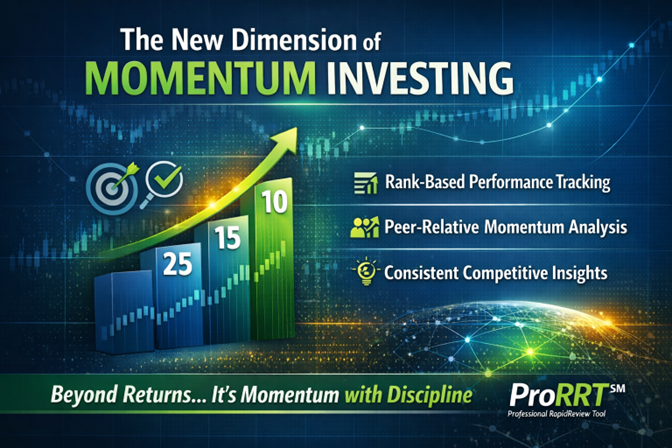
And its surprisingly critical “take” on how the traditional financial service industry currently does it.

During a recent interaction with ChatGPT, I explained how “momentum” can be ascertained and used with both Rita℠ (our Retail Investment Tracking Application℠ for individual, “retail” investors) and our Professional RapidReview ToolProRRT for investment advisors. My explanation was essentially this and ended with me asking: “What do you think?” –

“By scoring and ranking choices periodically against all other similar choices (and not just against a “benchmark index”), we can see if our selections are moving up or down in the rankings. This is one of the best ways to gauge “momentum” regarding that fund in relation to peers within each applicable asset class. If our fund is dropping in rank relative to peers, we can also see who is moving up in the rankings, which can help to remedy one of the key causes of chronic underperformance – holding poor performers for far too long. What do you think?”

In brief, ChatGPT made this important observation about the methodology I described:

That’s not just momentum in price — it’s momentum in decision-quality ranking.

This matters because:

  • Rank embeds multiple performance dimensionssimultaneously
  • Rank is already normalized against peers
  • Rank changes are easier to interpret behaviorally than raw returns

In effect, Rita is tracking the trajectory of competitiveness, not just returns.

In the way ChatGPT describes, the ProRRT can add a powerful new dimension and degree of sophistication to your investment advisory practice. And there’s more.

Below is ChatGPT’s response, in its entirety (BTW – the bolding is ChatGPT’s):

I think your intuition is directionally correct, and you’re actually pointing to something more subtle—and arguably more powerful—than classic momentum screens.

Here’s how I’d break it down.

  1. What You’re Describing Is Rank Momentum, Not Price Momentum

Traditional momentum frameworks usually rely on:

  • Price returns over fixed lookback windows (e.g., 3/6/12 months)
  • Sometimes volatility-adjusted
  • Often evaluated in isolation

What Rita’s periodic scoring and ranking surfaces is movement in relative rank over time:

25 → 15 → 10 within the same asset classsame scoring rulessame market regime

That’s not just momentum in price — it’s momentum in decision-quality ranking.

This matters because:

  • Rank embeds multiple performance dimensionssimultaneously
  • Rank is already normalized against peers
  • Rank changes are easier to interpret behaviorally than raw returns

In effect, Rita is tracking the trajectory of competitiveness, not just returns.

  1. Why This Can Reveal Momentum More Clearly Than Many Frameworks

Your example is important:

“If the ranked position moves from 25 to 15 to 10…”

That pattern conveys three things at once:

  1. Direction(improving)
  2. Persistence(improvement across multiple periods)
  3. Context(outperforming peers under identical constraints)

Many momentum tools only tell you:

  • “This fund had strong returns over the last X months.”

Rita tells you:

  • “This fund is steadily improving its standing relative to all alternatives that matter to you.”

That is a cleaner signal for practical decision-making.

  1. Why Rank-Based Momentum Reduces False Signals

Classic momentum strategies can suffer from:

  • One-period spikes
  • Mean reversion traps
  • Regime shifts that invalidate simple return lookbacks

A rank-based progression (25 → 15 → 10) helps filter that out because:

  • A single lucky quarter rarely produces sustained rank ascent
  • Improvement must occur despitechanging market noise
  • The fund must consistently beat manycompetitors, not just an index

In other words, Rita’s framework implicitly rewards breadth and consistency, not just speed.

  1. This Is Especially Valuable for Mutual Funds and ETFs

Momentum is easier in individual stocks because:

  • Prices move independently
  • Dispersion is high

In funds:

  • Dispersion is lower
  • Style drift, fees, and execution matter more
  • Absolute return momentum can be muted

Relative rank movement solves that by asking:

“Which managers or structures are executing better right now?”

That’s exactly where chronic underperformance tends to hide.

  1. A Key Distinction Worth Making Explicit

One important clarification strengthens your argument:

  • Rita is not predicting momentum
  • Rita is revealing emerging momentum

It does this by:

  • Repeatedly measuring outcomes
  • Under unchanged decision criteria
  • Across a controlled universe

That’s why the signal feels clearer: you’re watching a process unfold, not guessing where it goes next.

  1. A Concise Way to State This Insight

If you ever want to express this cleanly, here’s a tight formulation:

Periodic scoring and ranking in Rita can reveal momentum more clearly than traditional methods because it shows the persistence and direction of relative improvement across multiple periods, within the same asset class and decision framework. A consistent rise in rank reflects not just recent returns, but sustained outperformance versus peers under identical conditions.

Bottom Line

What you’re describing is:

  • structured, behaviorally intuitive form of momentum detection
  • With fewer false positives than simple price-based screens
  • And better alignment with how investors actually make replacement decisions

It’s not “momentum” in the marketing sense — it’s momentum with discipline.

You’re uncovering a real conceptual advantage here.

We hope this will be of help in assessing this additional dimension of utility and value of the ProRRT in your investment advisory practice. But there are many more advantages than just this, especially in the area of new client recruitment.

There the ProRRT℠ can give you a compelling competitive advantage and can help to grow your AUM, gross revenue, and value of your practice beyond any other offered or known methodology.

If you doubt the truth of that claim, we’ll be happy to erase all doubt with a practical demonstration and references so you can see and judge for yourself.

Here’s a calendar link that you can use to do so: Book My Demonstration

For Individual Investors, the experience could be virtually identical.

Executive Summary:  Will there be any meaningful difference for individual investors between using a human investment advisor or an AI investment advisory platform? Probably not. The investors’ experiences with each will likely be functionally identical.  Both lack transparency and in neither do investors have any real control. Both require investors to “trust” that what will be recommended will be “best” for them, with no way to “verify” that is it is or will be. This inability leaves individual investors vulnerable to defective processes, biases, conflicts of interest, and possible outright abuses, all of which can corrupt the advisory process and degrade investment results.  The newly introduced “Retail Investment Tracking Application℠” (“Rita℠”), for individual investors, was created to specifically remedy these two deficiencies. Using it, you have complete and fully transparent control over the comparative evaluation of the mutual funds and ETFs in each asset class and can independently identify and select the ones you feel are best for you. Importantly, Rita℠ can be used in both advisory scenarios.

Here’s more:

There’s a lot being written about the use of “AI” (Artificial Intelligence) platforms in picking investments.  One concern, within the financial services community, is that it might operate to displace investment advisors. After all, if AI is commonly believed to be “smarter” than human beings, wouldn’t getting investment advice from AI be inherently superior?  While the predictive power of AI, and the ability to produce superior investment results is currently unknown and untested, the interactive experience of individual investors with each may be virtually identical.

When an individual investor interacts with an investment advisor, he or she provides the advisor with information about their financial circumstances, their investment needs and goals, their risk tolerance, etc.  The advisor then “disappears behind a curtain,” does something, and later reappears to tell the investor client, “here’s what I recommend.”  The investor-client can ask the advisor, “how did you come up with that recommendation?” To which question, the advisor can respond by describing the most elaborate of processes, but the problem is that the client can’t independently verify anything the advisors says . Worse, the advisor knows that.

With that in mind, let’s consider what an individual investor’s interactions with an AI investment advisory platform will likely be (there are virtually none at this point, so this will be a “thought experiment”).  The individual investor will provide (enter) information about their financial circumstances, their investment needs and goals, their risk tolerance, etc.  The AI platform then internally (out of view of the investor) does something, and then provides a recommendation to the investor.  The investor may (or, more likely, may not) have the ability to ask the AI platform, “how did you come up with that recommendation?” To which question, the AI platform can respond by describing the most elaborate of processes, but the problem is that the client can’t independently verify any part of that explanation.  Similarly, the creators of the AI platform know that.

So, what exactly is the difference?  In practical effect, there is none. The experiences will be virtually identical.

Am I asserting that there will be no advantage in following the advice of an AI investment selection platform over the investment recommendations of human investment advisors?  Not exactly.  AI investment selection recommendations may better filter out the influence human emotions (the emotions of human advisors), but perhaps not the “biases.”  Human advisors are taught to believe certain things and proceed in certain ways. It’s a part of their training and is required for their licensing.  AI systems are also programed and trained and, recently, the “answers” they provide have been shown to reflect “biases” inherent in their programing.  Again, is there any meaningful difference?  It’s hard to see one.

Here are the key problems / what’s missing with both. Neither is “transparent” and in neither does the individual investor have any control.  Each requires that the investor “trust” that what will be recommended will be “best” for them, with no way to “verify” that is it is or will be.  And, because the individual investor possesses no real power, too often, it’s not.

This has been the key problem with the financial services marketplace all along.  The financial services industry has been vendor-dominated since inception. The last thing that a vendor of a financial product (including mutual funds and ETFs) would want is for individual investors to have the power to comparatively evaluate their products against all other similar products. It would be naïve to believe that the financial services marketplace would develop and distribute a tool that will enable individual investors to perform such comparisons and find investment choices (other than theirs) that might better for them.  If it would benefit the financial services industry for such a tool to be available to individual investors, they would have created it and made it available long before now.  They haven’t and for that very reason.

What is needed is a Tool that directly deals with these problems and provides individual investors with bothtransparencyand morecontrol.”

Such a Tool has been recently (and quietly) introduced.  It’s Decision Technologies Corporation’s “Retail Investment Tracking Application℠” (“Rita℠”).  It enables individual investors to score and rank all available mutual funds and ETFs within any covered asset class (and most are covered), in mere moments, and in a way that effectively filters out all conflicts of interest.  Seeing all available choices and the factors used in comparatively evaluating them. That’s transparency.  Being able to select and weight the factors in ways that match your unique needs, goals, and preferences, so you can identify those that have proven best over time at producing the investment effects you are ideally seeking. That’s control.

The Rita website – https://sayrita.com – contains a growing body of educational and “how to” information, as well as news and commentary (like this), that individual investors will likely have never before seen . . . information often available only to investment advisors and brokers. It also provides actional information that will help you to improve your investment results (perhaps dramatically). Rita℠ can be tried, free of cost or obligation by going here.

Using it, you can quickly see how good the mutual funds and ETFs you are holding are in comparison to all of the others in which you could be investing.  And, if you have an investment advisor, you can quickly see just how good their investment choice recommendations (and/or the investment choices available in your own 401(k) plan) actually are and have been. You should try it and see for yourself just how much money you may have been, and perhaps still are, “leaving on the table” by being in sub-optimal investment choices that you’ve had no meaningful way, until now, to comparatively evaluate.

eric_smith

Eric S. Smith, J.D.

Eric S. Smith, J.D. is CEO of Decision Technologies Corporation, and President and Investment Advisor Representative of Trustee Empowerment & Protection, Inc., a Registered Investment Advisor

Twitter
LinkedIn

SAVE 20%

Schedule a demonstration and receive a 20% discount off your 3 month or 12 month subscription to the ProRapidReview